
Museum Blog - May 2014
Construction began on the two spans of the New York Railway & Ottawa international bridge at Cornwall in 1898. In early September of that year, Pier Two on the American span failed, claiming 15 lives. After repairs were completed, the two bridges opened to rail traffic along the 129-mile line and remained in use until a second failure occurred in 1908.
The Cornwall Freeholder reported on June 26, 1908:
“The worst break in the history of the Cornwall Canal occurred on Tuesday morning of this week, when a large section of the south bank, just above Lock 18, was washed into the river. The collapse also destroyed the swing bridge of the Ottawa & New York Railway, which crossed the canal at that point, after the pivot pier on which it rested gave way.”
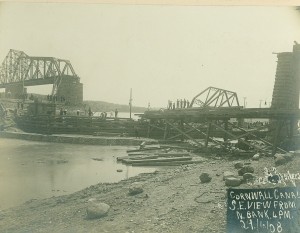
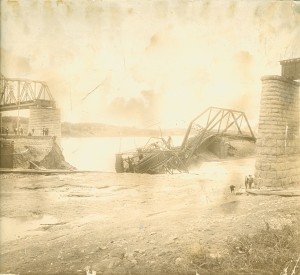
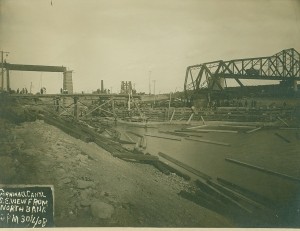
The first sign of trouble came at 4:45 a.m., when Lockmaster Michael Gleeson noticed that the river water had become unusually dirty. This suggested the possibility of a breach in the canal bank, and further investigation revealed a large leak a few yards west of the O&NY Railway Bridge, about 500 feet west of Lock 18.
Water was pouring through the rough stone wall along the riverbank, below the bottom of the canal. At first, the leak was about the size of a barrel, but it quickly grew. Before long, the entire bank gave way under the tremendous pressure of the water.
This level of the canal was about 200 feet wide, one and a quarter miles long, and 14 feet deep. For some distance near the break, the bank had been supported on the outside by a heavy dry-stone wall, reinforced at intervals with dovetailed piers. The gap in the bank soon widened to 150 or 160 feet, as the force of the water swept masonry and earth into the river as if they were chaff.
As soon as the leak was discovered, Lockmaster Alexander Eamer opened all the valves at Lock 18 and telephoned Lock 19, instructing them to close their valves. At the same time, he asked the lockmen at the locks below him to lower their water levels.
Despite these precautions, the rush of water through the break and into the river, 25 or 30 feet below, was tremendous. Before long, water from the level below Lock 18 forced the gates back and added to the flood by flowing westward, or upstream.
The torrent rushed around the base of the centre pier of the swing bridge, and at about 6 a.m. the pier gave way. It appeared to buckle in the middle, causing the bottom of the pier to turn upward. At the time, the bridge was open, lying parallel with the canal, with its ends resting on wooden trestles. These supports could not withstand the strain, and the bridge collapsed onto the wrecked pier, twisting badly out of shape and breaking apart.
By 7 a.m., the canal level was dry, except for leakage from the lock above and some surface water. A temporary bridge opened in November 1908, and the permanent bridge reopened in 1909.